When beginners learn digital marketing, they usually focus on tools.
They learn SEO tools, ad dashboards, analytics platforms, and social media apps. But there is one skill that quietly decides whether all those tools will work or fail.
That skill is Audience Intent Mapping.
I remember feeling confident after learning basic digital marketing terms, but confused when real results didn’t follow. That gap between knowledge and application is where intent mapping quietly plays a role.
Most beginners don’t even know it exists — yet every successful digital marketer uses it, knowingly or unknowingly.
What Is Audience Intent Mapping?
Audience intent mapping means understanding what a person actually wants when they search, click, or scroll online — not just what they type.
For example, when someone searches:
- “SEO tips”
They could be:
- A beginner trying to learn basics
- A business owner wanting fast growth
- A student preparing for interviews
The keyword is the same, but the intent is different.
Audience intent mapping is the skill of identifying that difference and creating content or ads that match it.
Why This Skill Matters More Than Tools
Many beginners face this problem:
“I used the right keywords, wrote good content, but it didn’t work.”
Most of the time, the issue is not the keyword or the content quality.
The issue is intent mismatch.
If your content does not match what the reader expects, Google notices — and users leave.
Intent mapping fixes this problem at the root.
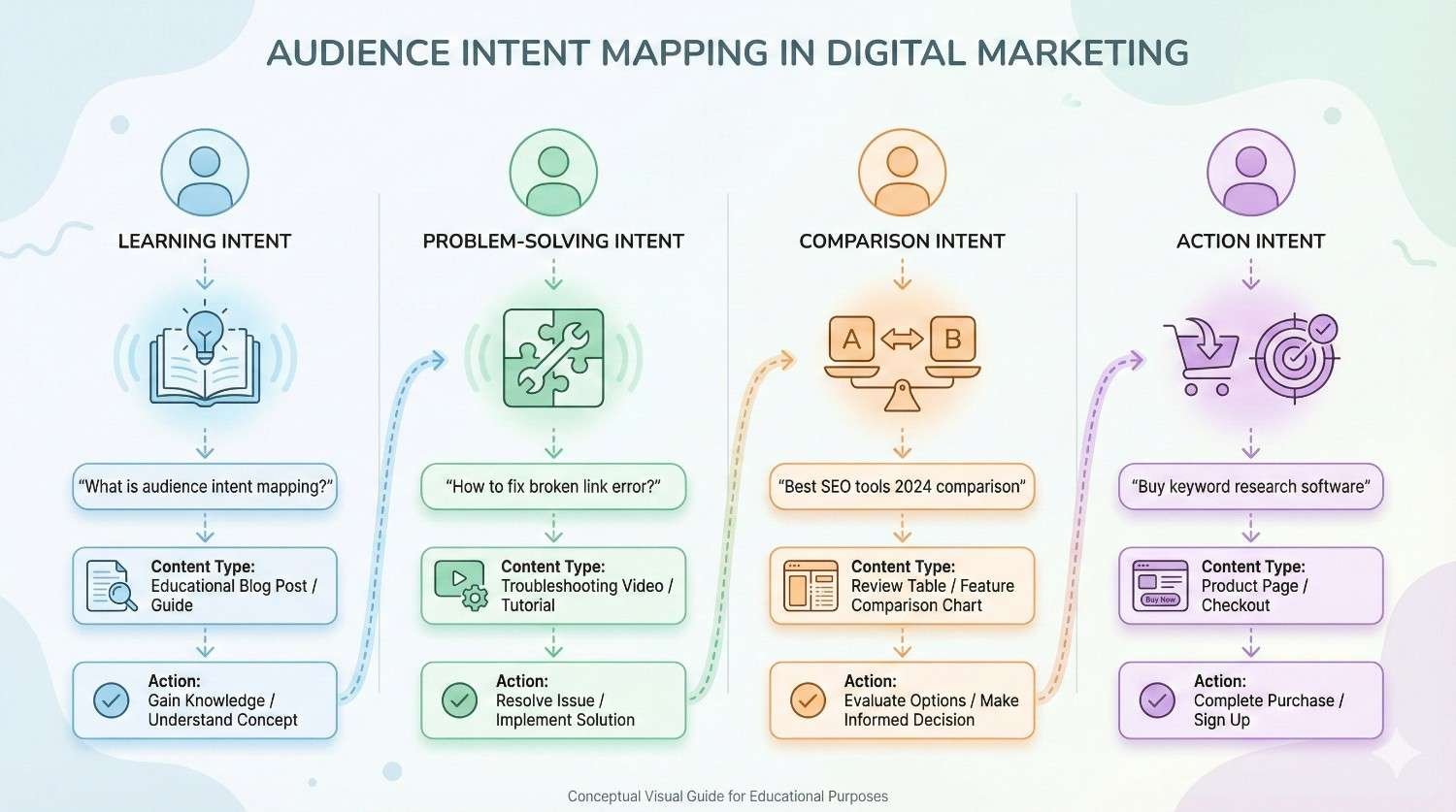
The Four Types of Audience Intent (Simple Version)
Instead of complex theory, think of intent in four clear types.
1. Learning Intent
The person wants to understand something.
Examples:
- What is digital marketing
- How SEO works
- Email marketing explained
Best content style:
- Simple explanations
- Examples
- Beginner-friendly language
Selling here fails. Teaching works.
2. Problem-Solving Intent
The person already knows basics but is stuck.
Examples:
- Why my website is not ranking
- Instagram reach suddenly dropped
- Google Ads not converting
Best content style:
- Clear solutions
- Step-by-step fixes
- Common mistakes
This is where trust is built.
3. Comparison Intent
The person is deciding between options.
Examples:
- SEO vs Google Ads
- Canva vs Photoshop
- Free vs paid marketing tools
Best content style:
- Honest comparisons
- Pros and cons
- No bias
Over-promising here destroys credibility.
4. Action Intent
The person is ready to act.
Examples:
- Best SEO tools
- Digital marketing course
- Hire social media manager
Best content style:
- Clear information
- Transparency
- No pressure
If previous intent stages were handled well, this stage converts naturally.
Why Beginners Struggle With Intent Mapping
Beginners usually make one mistake:
They try to sell, teach, explain, and rank — all in one article.
This confuses both:
- The reader
One article should target one dominant intent, not all.
Understanding this alone improves content performance drastically.
How to Practice Audience Intent Mapping (Beginner Method)
You don’t need tools for this. You need observation.
Before writing, ask:
- Who is searching this?
- What stage are they in?
- What would help them most right now?
Then write only for that stage.
For example:
If the topic is “What is SEO?”
Do not:
- Add tool lists
- Add pricing
- Add advanced strategies
Clarity beats completeness.
How This Skill Improves Every Area of Digital Marketing
Once you understand intent mapping:
- SEO improves (lower bounce rate)
- Ads perform better (relevant messaging)
- Content feels more human
- Engagement increases naturally
- Trust builds faster
It’s a silent skill, but a powerful one.
Why This Skill Is Rarely Taught Directly
Most tutorials focus on:
- Tactics
- Hacks
- Tools
- Shortcuts
Intent mapping is a thinking skill, not a tool-based skill.
That’s why it’s rarely explained clearly — but once learned, everything else makes more sense.
Final Thoughts
Digital marketing is not about tricks.
It’s about understanding people.
Audience intent mapping trains you to think from the user’s perspective instead of the marketer’s.
If beginners learn this skill early, they save months of confusion and wasted effort.
One of the biggest lessons I learned was that good digital marketing is less about clever tactics and more about understanding people. Once that shift happened, everything else started making sense.
At Skillash, the focus is not just on what to do, but how to think while doing it.
And this skill is a perfect place to start.