When people learn digital marketing, they usually focus on creating more content.
More blogs.
More pages.
More posts.
But very few beginners are taught an equally important skill — content pruning.
This is the skill of knowing what to keep, what to improve, and what to remove from your website or content strategy.
It may sound counterintuitive, but sometimes removing content improves performance more than adding new content.
What Is Content Pruning?
Content pruning means reviewing existing content and deciding whether it is still useful, relevant, and helpful.
This could involve:
- Updating outdated content
- Improving weak articles
- Merging similar posts
- Removing pages that add no value
The goal is not to reduce content, but to increase overall quality.
Why Beginners Often Ignore This Skill
Most beginners think:
“More content means more traffic.”
When I first started working on content, I believed growth only came from publishing more articles. It was only later—after revisiting old posts—that I realized improving or removing weak content often made a bigger difference than creating something new.
So they keep publishing without looking back.
I used to think the same way. For a long time, I believed growth only came from writing new articles, not from improving old ones. It was only later that I realized how much low-quality or outdated content can silently hurt a website.
This realization usually comes with experience, but it doesn’t have to.
How Too Much Weak Content Can Hurt a Website
When a site has many low-value pages:
- Users leave quickly
- Search engines get mixed signals
- Important pages lose importance
- Crawl budget gets wasted
Google prefers fewer high-quality pages over many weak ones.
Content pruning helps clean this noise.
What Kind of Content Needs Pruning?
You don’t delete content randomly. You prune with purpose.
Content that often needs attention includes:
- Very short or thin articles
- Outdated tutorials
- Duplicate or overlapping topics
- Pages that get no traffic and no engagement
Not all of this content should be deleted. Some just need improvement.
Content Pruning Is Not About Deleting Everything
A common misunderstanding is that content pruning means removing posts aggressively.
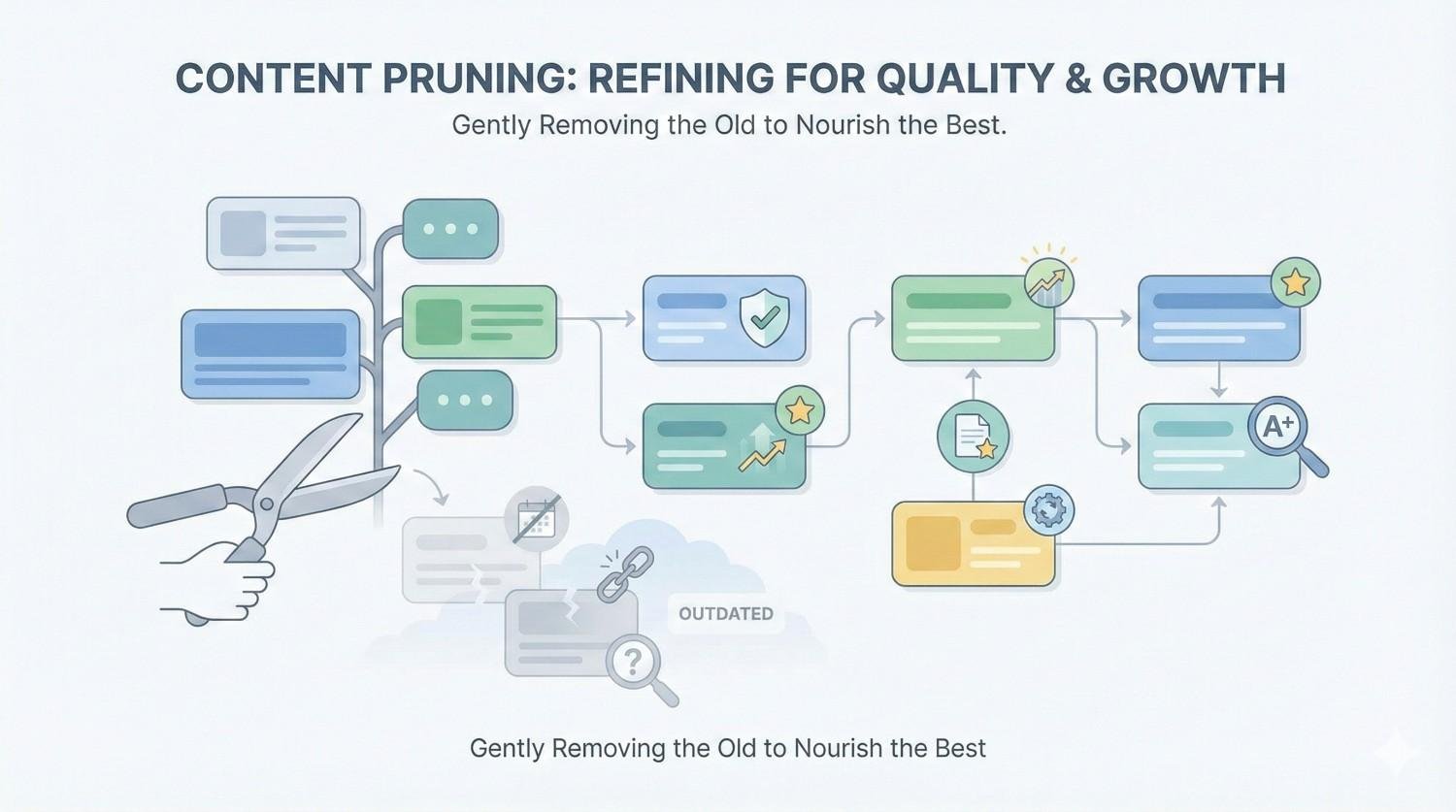
In reality, pruning has three outcomes:
- Update – Make the content better and relevant
- Merge – Combine similar articles into one strong post
- Remove – Delete content that serves no purpose
Knowing which action to take is the real skill.
Why This Skill Matters in Digital Marketing
Content pruning impacts multiple areas:
SEO
Search engines understand your site better when your content is focused and high quality.
User Experience
Users find what they need faster without distractions.
Authority Building
A clean site looks more trustworthy than a cluttered one.
Why Beginners Should Learn This Skill Early
Many people wait too long before cleaning their content.
By the time they realize the importance of pruning, they already have dozens of weak pages.
If beginners learn this skill early:
- They avoid unnecessary content
- They maintain quality over time
- Growth becomes more sustainable
A Simple Way to Practice Content Pruning
You don’t need advanced tools to start.
Once every few weeks, ask:
- Is this content still useful?
- Would I read this today?
- Does it help my reader clearly?
If the answer is no, improve it — or remove it.
Small clean-ups done regularly are better than big fixes later.
Over time, I learned that maintaining content quality is an ongoing process. Small improvements made consistently helped far more than chasing new content ideas without reviewing what already existed.
Final Thoughts
Digital marketing is not only about creating more.
It is also about maintaining clarity and quality.
Content pruning teaches you to think long-term instead of chasing numbers.
At Skillash, the goal is to help beginners understand not just how to grow, but how to grow responsibly. Learning when to pause, improve, or remove content is part of becoming a better digital marketer.
Sometimes, progress comes from doing less, not more.